
Industry Communication
Looking for Certainty? Then You Haven’t Reached Your Tipping Point
October 2026
From shifting manufacturing centers to lab-grown diamonds and changing demand, the diamond industry may be approaching several tipping points at once.
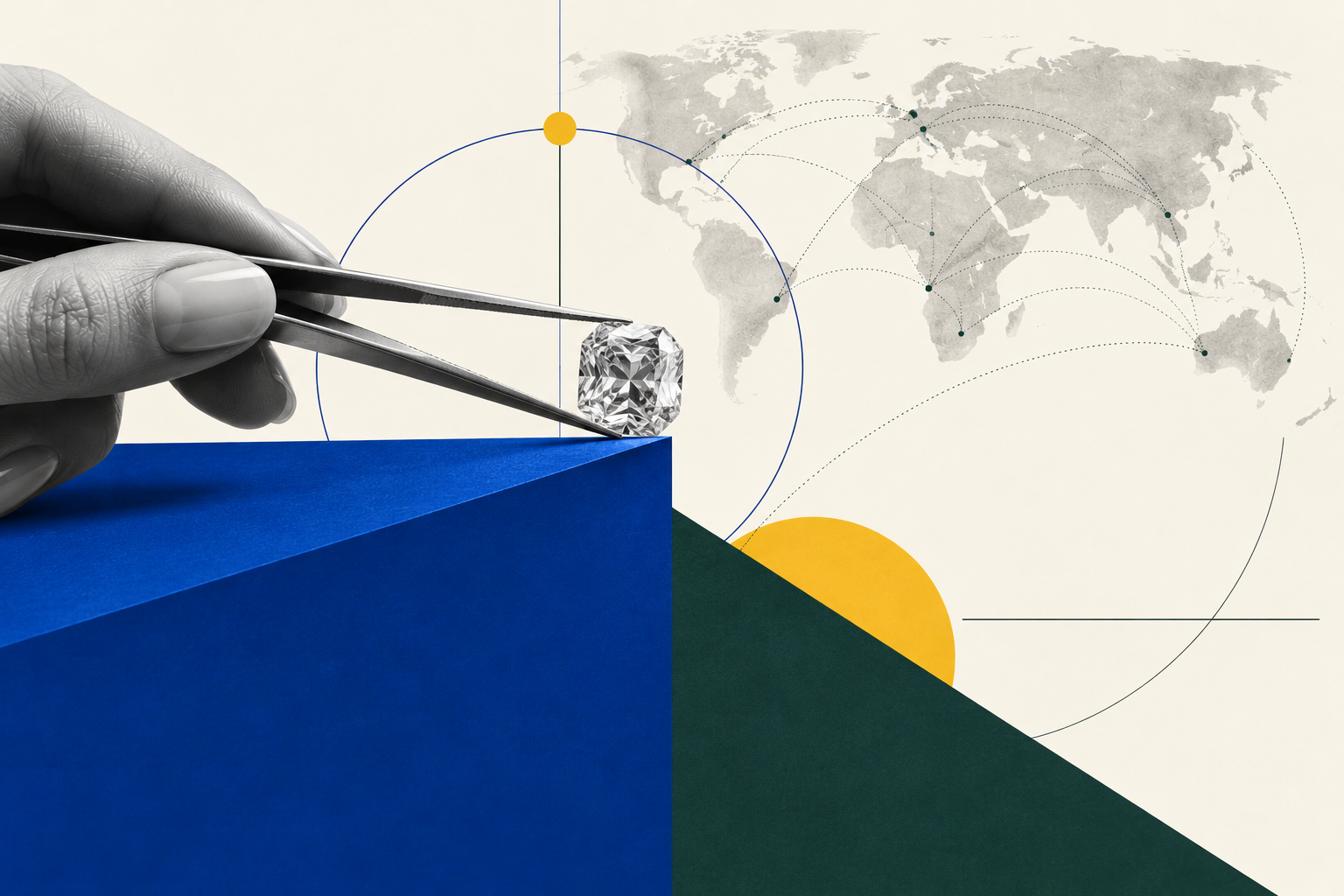
There was a time when “tipping points” were all the rage. Today, several diamond industry tipping points may be unfolding at once. Malcolm Gladwell’s 2000 bestseller, The Tipping Point: How Little Things Can Make a Big Difference, helped turn the expression into a staple of business presentations and political commentary.
For a while, it seemed that every minor development was being hailed as a tipping point, to the extent that the phrase itself was in danger of reaching a tipping point of overuse.
Yet the phenomenon remains very real. Indeed, today we may be living through several tipping points simultaneously.
A tipping point occurs when gradual change suddenly produces dramatic consequences: a political regime collapses, a technological breakthrough makes an established product obsolete, or a dominant company discovers that its customers have moved on. The difficulty is that tipping points are usually easier to recognize in retrospect. While they are happening, they tend to look like a collection of unrelated events and temporary setbacks.
In politics, empires weaken at their edges until their rulers discover that fear no longer guarantees obedience. For Syria’s Bashar al-Assad, the tipping point arrived in December 2024, when rebel forces captured Damascus and his regime collapsed.
Business has its own versions of the same story. Eastman Kodak, once synonymous with photography, failed to anticipate how radically the industry would change. Today, the telephone in our pockets has helped make photographic film largely unnecessary. Kodak understood photography; it failed to anticipate what photography would become.
Diamond Industry Tipping Points and the Shifting Center of Gravity
The diamond industry, in which we specialize, offers a compelling illustration. For generations, diamond cutting and polishing were concentrated in countries such as Belgium, the Netherlands, the United States, and Israel. Rising labor costs and increasingly sophisticated global supply chains shifted manufacturing toward lower-cost centers, particularly India and China, as well as Thailand and Vietnam.
Former manufacturing centers increasingly became trading, financing, and distribution hubs, while some saw much of their traditional manufacturing activity disappear. But as incomes rise in today’s manufacturing centers, where will production move next? Or will automation make the search for cheaper labor less important than the pursuit of more efficient technology?
Meanwhile, African diamond-producing countries are demanding a greater share of the economic value generated by their natural resources. Botswana, in particular, has sought greater control over its diamond business through its evolving partnership with De Beers. The old arrangement, under which rough diamonds were mined locally but much of the commercial value was generated elsewhere, is under increasing pressure.
Taken together, these shifts show why diamond industry tipping points can be difficult to recognize while they are still unfolding.
This marks a fundamental shift in the industry’s center of gravity, from north to south. But demanding a greater share of the business is easier than building a sustainable domestic industry. Investment, skills, infrastructure, and access to customers remain essential.
Few companies illustrate the fragility of market dominance better than De Beers. Once the defining force in the rough-diamond trade, it now faces weakening natural-diamond demand, falling prices, excess inventory, and competition from lab-grown stones. Anglo American, which owns 85% of De Beers, is advancing a sale process, making De Beers’ future ownership one of the industry’s most consequential questions in 2026. (according to Anglo American’s 2026 interim results).
The irony is striking. De Beers helped persuade generations that diamonds were forever. It must now demonstrate that its own business model can survive a changing market.
Perhaps the industry’s most profound challenge is technological. Lab-grown diamonds are chemically and physically diamonds, but they can be sold at substantially lower prices than comparable natural stones. For consumers seeking size and appearance at an affordable price, the attraction is obvious.
Natural diamonds cannot compete simply by trying to become cheaper. Their future depends increasingly on persuading consumers to value their geological origins, rarity, individuality, and connection to the natural world.
The market may be dividing into two distinct businesses: lab-grown diamonds competing on price and accessibility, and natural diamonds competing on rarity and luxury. That need not spell the end of natural diamonds, but it could end the assumption that all diamonds will follow the same commercial trajectory.
Who Will Buy the Diamonds?
The United States has long been the world’s most important diamond-jewelry market. China’s spectacular economic growth once promised a second engine of demand, as an expanding middle class embraced luxury goods.
But the story has proved more complicated. Economic uncertainty, a troubled property market, and changing consumer preferences have weighed on Chinese luxury spending. Meanwhile, American consumers have increasingly embraced lab-grown diamonds, particularly for engagement rings.
Nor is global economic leadership simply transferring from Washington to Beijing. China’s economy is larger by purchasing power parity, while the United States remains larger in nominal-dollar terms. Economic power does not automatically translate into dominance in every consumer market.
For the diamond industry, the lesson is clear: relying indefinitely on a single market to drive growth is a risky strategy.
The Next Tipping Point
Across the diamond business, manufacturing geography, corporate ownership, technology, and consumer preferences are changing simultaneously. Each development might be dismissed as temporary. Together, they could signal a fundamental transformation.
That is why diamond industry tipping points rarely announce themselves in advance. One change may seem manageable; several, moving together, can alter the direction of an entire market.
Benjamin Franklin is often credited with observing that nothing is certain except death and taxes. Perhaps, in 2026, we should add a third certainty: change.
There is, however, one qualification. Change is certain; its direction is not. Those who insist that tomorrow must resemble yesterday may enjoy a comforting sense of stability—until they discover that the world has already moved on.
And if you’re still waiting for the moment when everything becomes predictable, you may be waiting for a tipping point that never comes.
Start a conversation
Have a communications project, publication or event to discuss? Get in touch.