
A Newsperson’s Life Before AI Was Different, But There’s No Looking Back
October 2026
The internet changed how journalists find information. AI is changing how they use it. The challenge is to work faster without giving up the judgment that makes journalism valuable.
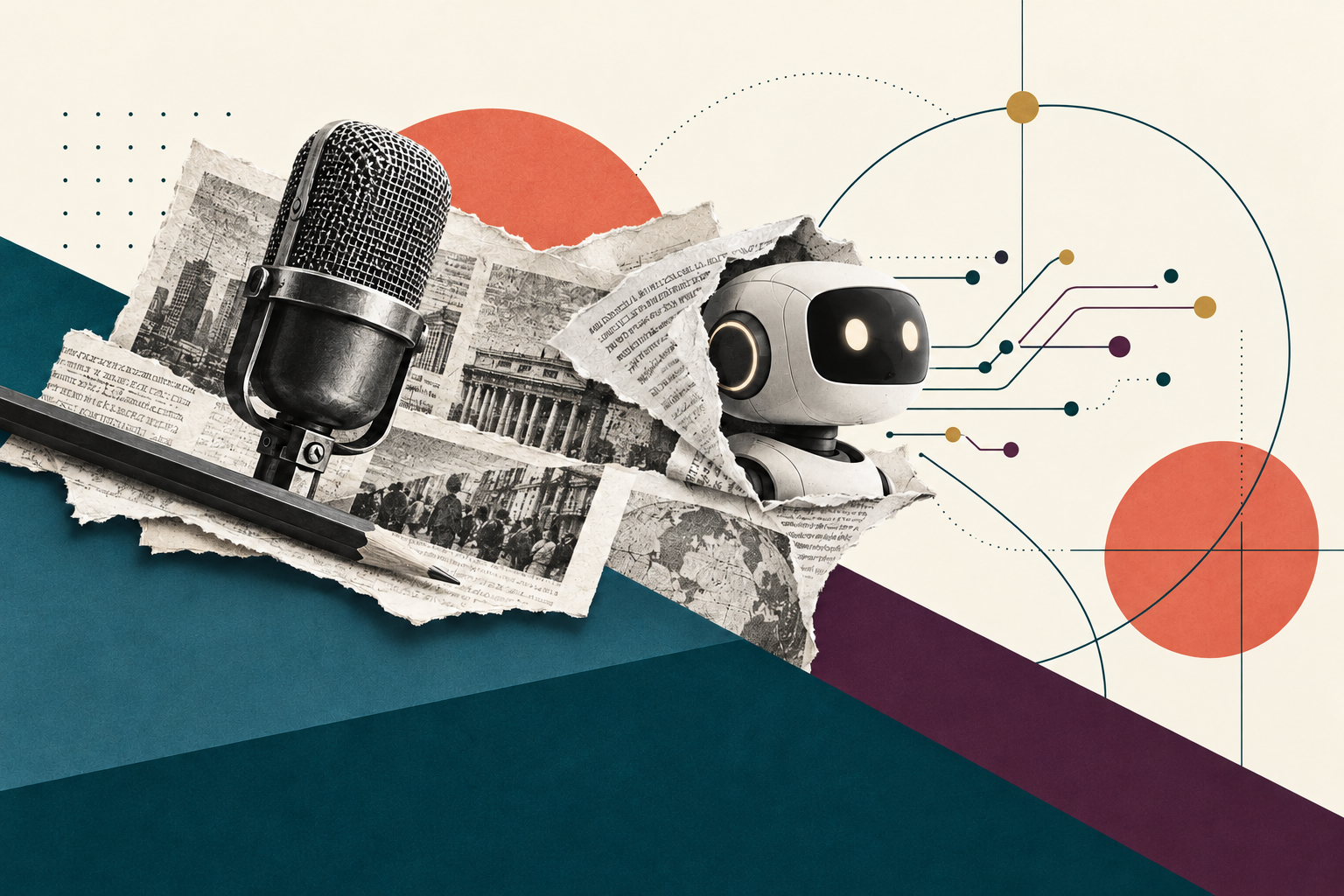
AI in journalism is changing how reporters research, analyze, and write the news. First the internet transformed how we find information; now artificial intelligence is changing how we process it and turn it into publishable copy. Does our growing dependence on AI make us more efficient—or simply lazier? Are journalists outsourcing professional instincts to machines in ways their predecessors would have found unimaginable?
For journalists who entered the profession in the 1980s or earlier, research took time. Background research meant asking the long-serving news editor or searching filing cabinets. Journalists hoped each clipping had been returned to its place. The clippings, pasted onto typing paper, were filed alphabetically.
Larger operations had more resources, including dedicated libraries staffed by people whose job was to find the article you needed. But daily newspaper deadlines, unlike the more relaxed schedules of weeklies and magazines, rarely allowed for such luxuries.
AI in Journalism: From Filing Cabinets to First Drafts
Then came the internet, followed by search engines such as Google. Suddenly, even the most modest weekly newspaper could access information that once required a dedicated library and a patient research assistant. Digital archives made old articles and photographs retrievable in seconds. A keyword replaced an afternoon in the filing room, and background research that once consumed hours could be completed in minutes.
AI is taking the next step. It can summarize documents and compare competing accounts. The technology can also identify patterns, suggest questions, or produce a first draft before a journalist finishes making coffee. Long reports and large data sets are easier to analyze, helping reporters make sense of material that once took days to process.
Journalists of yesteryear will remember early-morning newsrooms in which reporters energetically rifled through newspapers, searching for stories they might have missed. Today’s journalist can ask an AI assistant to identify the day’s most significant developments and suggest five possible angles for a story. We are not just living in different times; we are operating in different realities.
We could explain to our predecessors that today’s tools are essential if we are to publish breaking news seconds before our competitors. But they would rightly point out that they, too, fought daily battles to get stories onto newswires, into radio and television broadcasts, and onto newspaper front pages. The technology has changed; the race to be first has not.
Journalists who began their careers before the digital revolution occupy an unusual position. We remember the old methods while working in an environment that would have seemed like science fiction to our younger selves. Before “cut and paste” became a keyboard shortcut, it was a physical task. A typesetting employee cut out photographic paper with text and pictures. Then the pieces were pasted onto a grid of the newspaper page.
The production process has become astonishingly efficient. Articles can be drafted, edited, illustrated, and published in a fraction of the time once required. Page-design software has replaced much of the manual work, while automated systems have taken over tasks that once demanded entire departments. AI promises to accelerate the process further, potentially changing not only how journalists work but also how many people news organizations employ.
What AI Can Do - and What It Cannot
Would we really trade these conveniences for the privilege of waiting hours or days for information? Would we willingly return to a world in which producing a newspaper was laborious, when readers expect news almost as it happens? Digital platforms allow stories to appear within minutes.
Of course not. The question is not whether journalism should embrace new technology. It is whether journalists can use it without surrendering the skills that make journalism valuable in the first place.
The Associated Press newsroom standards for artificial intelligence provide a current example: the organization says it will evaluate where AI can responsibly improve newsroom workflows while maintaining editorial standards and human oversight.
AI can produce a convincing summary of a report without understanding its significance. It can deliver a confident but factually incorrect answer, invent a source, or overlook the crucial detail that turns an ordinary story into an important one. It can help identify inconsistencies, but it cannot replace the responsibility to verify a claim, question a source, or recognize when a seemingly minor detail deserves closer investigation.
The danger is not simply that AI might replace journalists. It is that journalists might become so dependent on AI that they stop doing the very things for which journalists are needed.
Why Human Judgment Still Matters
The same principle applies across business. Technology can make established processes faster and cheaper, but efficiency alone does not guarantee better decisions. Expertise, judgment, and the ability to distinguish meaningful information from noise remain essential.
Time has moved on, and there is no going back. The internet changed how we find information; AI is changing how we use it. Those who refuse to adapt risk becoming irrelevant. Those who embrace every new tool without questioning its output risk something potentially worse: becoming irrelevant without even realizing it.
Can journalism become any faster than it is today? Almost certainly. Can AI make it better? That depends on the people using it.
I’ll ask AI to help me answer that question again in 20 years. If it still needs me to check the facts, perhaps there will be hope for journalism after all.
Start a conversation
Have a communications project, publication or event to discuss? Get in touch.